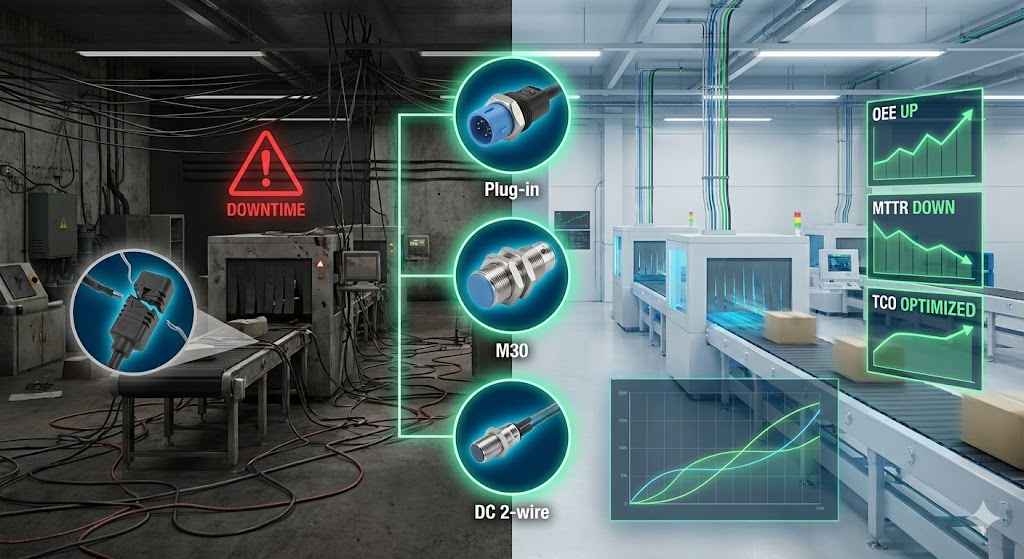
In today's pursuit of smart manufacturing, enterprises often focus their attention on expensive robotics or complex MES systems. However, frontline production data indicates that the primary culprits eroding Overall Equipment Effectiveness (OEE) are often not major equipment failures, but rather frequent minor issues and inefficient maintenance related to the thousands of foundational sensing components—proximity switches.
In modern factories, how can we uncover new efficiency gains by optimizing the edge sensing network? The answer lies in moving beyond the traditional "it works, it's fine" mindset and shifting towards a refined selection strategy based on Total Cost of Ownership (TCO).
Pain Point 1: The "Silent Killer" of Prolonged Maintenance TimeOn a production line valued at thousands of dollars per minute, replacing a damaged hardwired sensor can take 20-30 minutes for disassembly, rewiring, and debugging. The accumulated cost of this unplanned downtime is staggering.The Breakthrough: More benchmark factories are comprehensively adopting Plug-in Proximity Switches. By separating the sensing head from the cable, maintenance personnel can complete a "hot swap" in seconds without needing a specialized electrician. This shift directly compresses Mean Time To Repair (MTTR) by over 90%, significantly boosting equipment availability.
Pain Point 2: Efficiency Losses from Complex WiringAs equipment integration increases, wiring density inside control cabinets grows exponentially. Complex I/O wiring not only increases initial installation labor costs but also creates massive obstacles during later troubleshooting.The Breakthrough: Adopting highly reliable DC Two-Wire Sensors is becoming a trend to simplify system architecture. They connect directly in series with the load circuit, reducing cabling and I/O point usage by one-third, inherently lowering system complexity and the probability of errors.
Pain Point 3: Premature Failure in Harsh EnvironmentsIn heavy industrial scenarios full of oil, metal shavings, or strong vibrations, ordinary plastic-housed sensors often fail within months due to corrosion or impact. Frequent replacements not only increase spare parts costs but also disrupt production rhythms.The Breakthrough: For critical nodes, full-metal heavy-duty sensors (such as the M30 series) must be selected. Although the initial procurement cost is slightly higher, their lifespan, which is several times longer than ordinary products, significantly reduces TCO over the entire life cycle.
Conclusion: Micro-Upgrades Leverage Macro-BenefitsImproving OEE is not just a grand strategy; it is the ultimate pursuit of perfection at every micro-node. From choosing a more durable metal housing to upgrading to a more convenient plug-in interface, these seemingly insignificant changes converge into powerful corporate competitiveness. The Sense-the-World platform is dedicated to providing diverse sensing solutions that practically solve on-site pain points, helping manufacturing enterprises win the battle for efficiency through details.