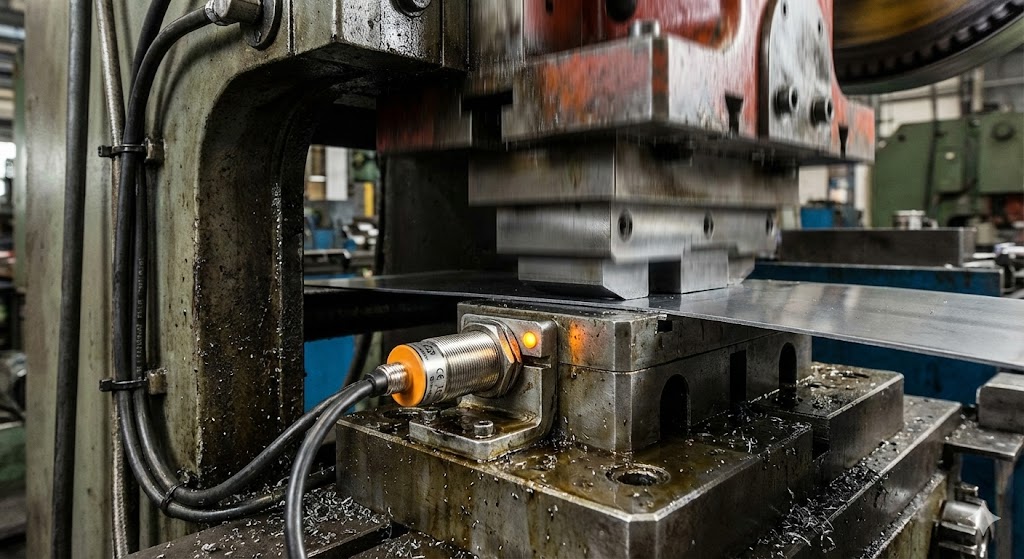
In the metal stamping industry, every reciprocating impact of the punch press slider not only shapes the part but also subjects the sensors installed within the die to thousands of "torture tests." Many factories frequently encounter issues where sensors fail due to vibration-induced wire breaks, cracked housings, or oil infiltration. Minor consequences include downtime and scrap, while severe cases can lead to expensive die damage (commonly known as "die crashes") due to misjudgment.
How do you choose this critical line of defense for a violent punch press? The answer lies in selecting Punch Press Specific Shock-Resistant Proximity Switches.
I. Core Pain Point: Why Do Ordinary Sensors Fail Quickly?
The instantaneous impact force (G-value) generated by a punch press is immense. The internal coils and circuit board solder joints of ordinary plastic-housed sensors easily loosen under continuous vibration. Furthermore, the stamping oils and coolants prevalent in the workshop are highly pervasive; once they infiltrate the sensor, they cause short circuits or sensitivity drift.
II. Selection Key: Three Elements of Hardcore Protection
Based on years of industry data from the Sense-the-World platform, sensors suitable for punch presses and die protection must possess the following characteristics:
Ultimate Shock-Resistant StructureWe recommend using Integrated Metal-Housed M12 or M18 Series. We utilize a special potting process to completely solidify the internal circuit board, enabling it to withstand high-intensity mechanical shock and preventing internal components from loosening.
Special Cable Exit ProtectionThe most vulnerable part of a punch press sensor is the cable root. High-quality punch press switches feature flexible strain relief (SR) at the exit point and use Oil-Resistant, High-Flex PUR Cables, ensuring they won't break due to fatigue during high-speed movement with the die.
Adaptation to Irregular SpacesSpace inside a die is extremely valuable. For many lower die or floating pin detection applications, cylindrical sensors simply won't fit. In these cases, Miniature Square Proximity Switches (e.g., 12x16x28mm) become the best choice. They can be mounted directly in tight die crevices to precisely monitor if the material is positioned correctly.
III. Typical Application Scenarios
Misfeed Detection: Monitors whether the sheet metal has reached the predetermined position to prevent empty or double hits.
Ejection Detection: Confirms whether the finished product has been successfully blown out to prevent jamming.
Bottom Dead Center (BDC) Monitoring: Monitors the stroke accuracy to ensure product consistency.
Conclusion
In stamping automation, a sensor costing a few dozen dollars often guards a die worth tens of thousands. Choosing the high-frequency, high-shock-resistant proximity switches from Sense-the-World (