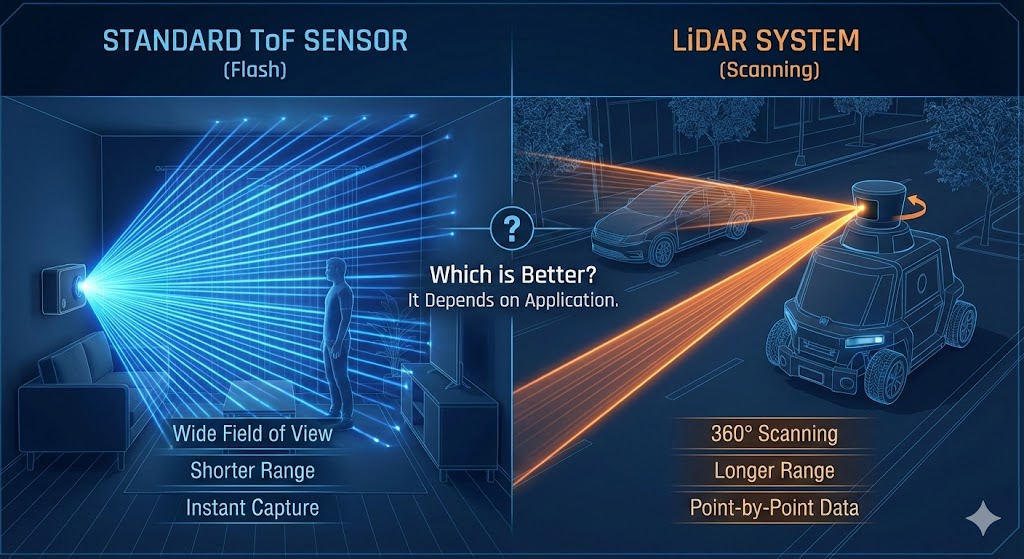
Descript: "Is LiDAR better than ToF?"This is one of the most common questions asked by product managers and engineers developing mobile robots (AGVs), drones, or smart home devices.The short answer is: No, it i
"Is LiDAR better than ToF?"
This is one of the most common questions asked by product managers and engineers developing mobile robots (AGVs), drones, or smart home devices.
The short answer is: No, it is not "better"—it is different.
In fact, comparing them is often a misunderstanding of terminology. LiDAR (Light Detection and Ranging) is a system application, while ToF (Time-of-Flight) is the underlying measurement principle. Most modern LiDARs actually use ToF technology to function.
However, in the industrial market, when suppliers say "ToF Sensor," they usually refer to Flash ToF cameras or single-point modules, whereas "LiDAR" refers to scanning systems.
Here is the breakdown of when to choose which.
1. The Fundamental Difference: Flash vs. Scan
Standard ToF (Flash ToF / 3D Camera): Think of this like a camera flash. It illuminates the entire scene at once with infrared light and captures depth data for every pixel simultaneously.
Pros: No moving parts (solid-state), compact, lower cost, high frame rate.
Cons: Limited range (usually < 10m) because the light energy is spread out.
LiDAR (Scanning ToF): It typically uses a focused laser beam that "scans" the environment point-by-point (using a rotating mirror or MEMS).1