A ToF (Time of Flight) distance sensor is a precision device that measures distance by calculating the time it takes for emitted light to travel to an object and return to the sensor. Compared with traditional infrared or ultrasonic sensors, ToF provides higher accuracy, faster response, and better performance in complex environments.
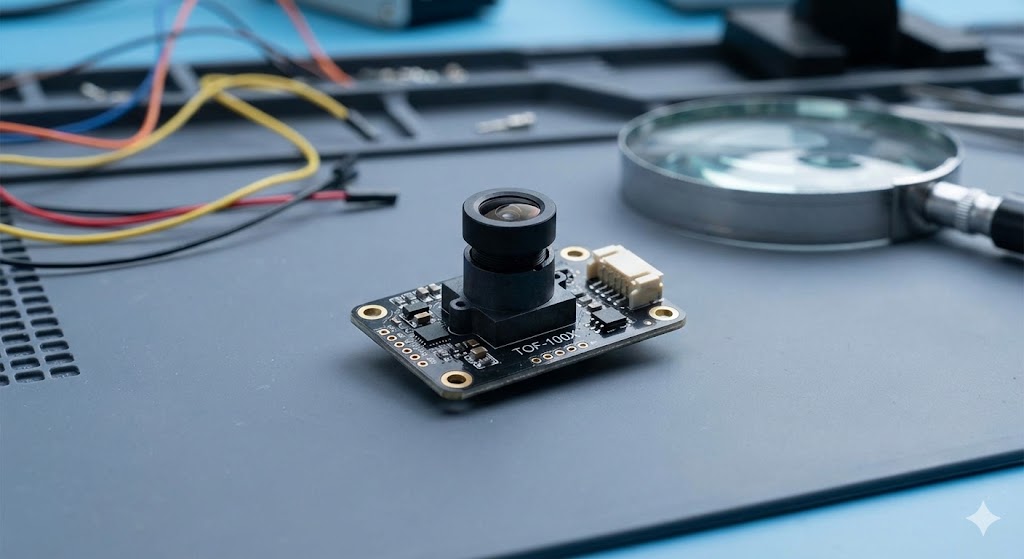
This article explains how a ToF sensor works, its advantages, applications, and how it compares to other distance-measuring technologies.
How Does a ToF Distance Sensor Work?
ToF sensors operate based on a simple physical principle:
The sensor emits a beam of light (usually near-infrared).
The light hits an object and reflects back.
The sensor measures the round-trip time of the light.
Using the formula
Distance = (Speed of Light × Time) / 2,
the sensor calculates the exact distance.
Because the speed of light is extremely fast, ToF modules integrate high-precision electronic timing systems to detect time differences in the nanosecond scale.
Key Features and Advantages of ToF Sensors
1. High Accuracy
Most ToF sensors achieve millimeter-level precision, making them suitable for applications requiring reliable distance measurement.
2. Long Detection Range
Depending on the model, the range may vary from a few centimeters to several meters.
3. Fast Response Time
ToF modules can output distance data at high frequencies, ideal for real-time detection scenarios like robotics or gesture control.
4. Strong Environmental Adaptability
Unlike traditional IR sensors, ToF sensors are less affected by lighting, background color, or object surface texture.
5. Support for 2D/3D Depth Mapping
Advanced ToF cameras can generate full-frame depth images for 3D sensing.
Common Applications of ToF Distance Sensors
● Robotics & Automation
Robots use ToF modules for obstacle detection, path planning, and precise positioning.
● Smartphones & Consumer Electronics
ToF sensors enable:
Face recognition
Gesture control
Portrait mode (bokeh effect)
● Industrial Automation
Used for:
Position monitoring
Level detection
Safety distance measurement
● Smart Home & IoT Devices
ToF is applied in smart faucets, automatic doors, and presence detection systems.
● Drones
Assist with altitude hold, landing, and collision avoidance.
ToF vs. Other Distance Measurement Technologies
| Technology | Principle | Advantages | Disadvantages |
|---|---|---|---|
| ToF | Light flight time | High accuracy, stable, fast response | Cost slightly higher |
| Infrared Reflection | Light intensity change | Low cost | Accuracy affected by surface/color |
| Ultrasonic | Sound wave reflection | Good for large objects | Slow, affected by temperature |
| Laser Rangefinders | Laser reflection | Long distance, high precision | Expensive, bulky |
ToF provides a balance of accuracy, speed, and cost, making it increasingly popular across industries.
How to Choose a ToF Distance Sensor?
When selecting a ToF sensor, consider:
Detection range (e.g., 0.1–2 m)
Accuracy and resolution
Field of view (FOV)
Output interface (I2C, UART, SPI, etc.)
Ambient light tolerance
Power consumption
Size and mounting requirements
Choosing the right module ensures better integration into your project or product.
Conclusion
A ToF distance sensor is a modern, high-precision solution for distance measurement. With its excellent accuracy, strong environmental adaptability, and diverse application scenarios, ToF technology is becoming a mainstream choice in robotics, consumer electronics, industrial automation, and IoT.
If you're building a product that requires stable, fast, and reliable distance sensing, a ToF sensor is likely the ideal option.